
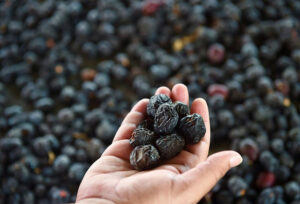
Ajwa dates come from Madinah in Saudi Arabia. They are small, roundish and near-black, with finely wrinkled skin and a soft bite. Many health claims are made for them, from blood pressure to heart and liver protection. This article checks those claims against published research and separates what has been tested in people from what has only been seen in rats or test tubes. Whichever Pembekal Kurma malaysia you buy from, the research below is about the fruit itself, not any brand.
This article is general information, not medical advice. If you have a health condition or take regular medicine, talk to your doctor before changing your diet.
What is in an Ajwa date
A 2013 laboratory analysis of Ajwa dates measured 39.06% fructose, 26.35% glucose, 11.01% fibre and 1.33% soluble protein, with the seed making up 13.24% of the fruit. Another composition study reported substantial amounts of carbohydrates, energy, potassium, iron, polyphenols and flavonoids.
In plain terms, they are mostly sugar, with a useful amount of fibre and a little protein. They can be eaten as a snack, or mixed with warm milk or honey.
Hunger pangs and fibre
Fibre is the part of the fruit with the clearest everyday use. The NHS lists not eating enough fibre as a cause of constipation and advises increasing the fibre in your diet. With about 11% fibre in the 2013 analysis, these dates can help with that.
A PubMed search found no study measuring whether these dates reduce hunger pangs, so we make no claim about appetite. Because they are mostly sugar, a few dates go a long way: our guide to managing date consumption for better health covers sensible portions.
Blood pressure, potassium and sodium
The Ajwa composition study above reported substantial potassium, and USDA FoodData Central lists Medjool dates at 696 mg potassium and 1 mg sodium per 100 g; those figures are for Medjool, not Ajwa. A 2013 BMJ meta-analysis of 22 randomised trials with 1,606 participants found that higher potassium intake lowered systolic blood pressure by 3.49 mmHg and diastolic by 1.96 mmHg in adults, an effect seen in people with high blood pressure but not in those without it. Those trials studied potassium intake, not dates.
When dates themselves were tested, the result was flat. In a 2022 randomised trial, 79 adults with type 2 diabetes ate 60 g of dates or 60 g of raisins daily for 12 weeks; 61 finished, and there was no difference between or within groups in systolic or diastolic blood pressure. That trial did not name Ajwa. So it is not accurate to say Ajwa dates control blood pressure. People with kidney disease should also be careful with potassium-rich foods: the NHS notes that people with chronic kidney disease can develop high blood potassium.
Cholesterol
Ajwa dates have been tested for cholesterol mainly in animals. In rats fed a cholesterol-rich diet, a polyphenol extract of the fruit lowered total hepatic cholesterol, LDL, VLDL and triglycerides and raised HDL. An extract given to rats is not the same as eating the fruit.
In people, the closest evidence is a 2023 randomised trial of Ajwa date pit powder: 40 adults with raised cholesterol and triglycerides and a BMI over 25, all on statin medicine, took 2.7 g of seed powder or the same amount of wheat flour daily for 40 days. Total and LDL cholesterol fell significantly with the seed powder, and that group lost more weight than the control group. That study used ground seeds, not the flesh you eat. For dates in general, a 2025 meta-analysis of four studies with 298 people with type 2 diabetes found a reduction in total cholesterol but no significant change in LDL, triglycerides or HDL, and asked for larger studies.
A PubMed search found no study of this variety and atherosclerosis, heart attack or stroke.
Liver and heart: animal studies only
In animal work, extracts of the fruit have protected the liver, but there is no human proof yet. In a rat study, an extract of the fruit given before and during carbon tetrachloride exposure lowered liver enzyme levels and markers of oxidative stress and apoptosis, which the authors linked to antioxidant activity. In another rat study, a freeze-dried Ajwa extract reduced heart damage caused by the drug isoproterenol. These results are interesting but come from extracts in rodents; they do not show that eating the fruit treats heart or liver disease.
Inflammation
These dates are often described as anti-inflammatory. In the 2013 laboratory study, Ajwa extracts had a cyclooxygenase inhibitory effect in test-tube assays, inhibiting the COX-1 enzyme by 30 to 32% and COX-2 by 45 to 59% at 100 μg/mL. That is a lab measurement, not a result in people.
Two small human studies have measured inflammation markers, both in people with schizophrenia taking risperidone. In a 2025 randomised study of 44 patients with schizophrenia treated with risperidone, those who also ate seven Ajwa dates a day (60 to 80 g) for 8 weeks had higher quality-of-life scores and lower levels of the inflammation marker TNF-alpha than those on risperidone alone. A second 2025 quasi-experimental study of 60 patients, using the same seven dates a day for 8 weeks, found a greater fall in the inflammation marker IL-1β than in the group on risperidone alone. Both were small studies in a specific group, so it cannot be applied to healthy people.
How much of this adds up
A 2020 systematic review of date palm clinical trials found 26 studies, 38% of them randomised controlled trials, with performance and detection bias in 80%. It concluded there is not enough clinical evidence to support many of the health effects claimed for dates. Ajwa is a fibre-rich fruit, but the stronger claims made for them are not yet proven in people.
For more on the variety, read our pages on the unique characteristics of kurma Ajwa and the allure of kurma Ajwa.
References
- Zhang CR et al. Antioxidant and anti-inflammatory assays confirm bioactive compounds in Ajwa date fruit. J Agric Food Chem 2013;61(24):5834-40. PMID 23713661
- Alqarni MMM et al. Antioxidant and antihyperlipidemic effects of Ajwa date (Phoenix dactylifera L.) extracts in rats fed a cholesterol-rich diet. J Food Biochem 2019;43(8):e12933. PMID 31368543
- NHS. Constipation. nhs.uk/conditions/constipation
- USDA FoodData Central. Dates, medjool (FDC 168191). fdc.nal.usda.gov
- Aburto NJ et al. Effect of increased potassium intake on cardiovascular risk factors and disease: systematic review and meta-analyses. BMJ 2013;346:f1378. PMID 23558164
- Butler AE et al. Effect of date fruit consumption on the glycemic control of patients with type 2 diabetes: a randomized clinical trial. Nutrients 2022;14(17):3491. PMID 36079749
- NHS. Chronic kidney disease: treatment. nhs.uk/conditions/kidney-disease/treatment
- Nasrullah PR et al. Effect of Ajwa date pits powder on body composition, lipid profile and blood pressure in patients with hyperlipidemia: a randomized clinical trial. Avicenna J Phytomed 2023;13(2):143-152. PMID 37333476
- Mirghani HO, Alhowiti A. Dates fruit effects on dyslipidemia among patients with type-2 diabetes mellitus: a systematic review and meta-analysis of randomized trials. Pak J Med Sci 2025;41(1):331-337. PMID 39867809
- Elsadek B et al. Abrogation of carbon tetrachloride-induced hepatotoxicity in Sprague-Dawley rats by Ajwa date fruit extract. Pak J Pharm Sci 2017;30(6):2183-2191. PMID 29175788
- Al-Yahya M et al. 'Ajwa' dates extract ameliorates isoproterenol-induced cardiomyopathy in rodent model. Phytomedicine 2016;23(11):1240-8. PMID 26776662
- Rismayanti et al. Effect of Ajwa dates on quality of life and serum TNF-alpha levels in patients with schizophrenia treated with risperidone: a randomised controlled study. East Asian Arch Psychiatry 2025;35(1):11-15. PMID 40170205
- Syamsuddin S et al. Effect of Ajwa dates adjuvant therapy on improvement of clinical symptoms and serum interleukin-1β (IL-1β) levels in schizophrenia patients. Riv Psichiatr 2025;60(5):202-213. PMID 41070421
- Bagherzadeh Karimi A et al. Clinical effects of date palm (Phoenix dactylifera L.): a systematic review on clinical trials. Complement Ther Med 2020;51:102429. PMID 32507440